 Carinsider
Jeep, Kübelwagen and Dingo: What Wartime Test Drivers Found
Classic Cars·November 17, 2026
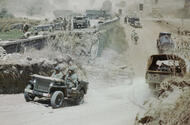
Few vehicles define a war the way the Jeep defined the Second World War. Cars and light vehicles have been central to military operations for more than a century, handling patrols, reconnaissance, radio work, escorts and supply runs. Among the many designs that appeared in the 1940s, the quarter-ton Jeep stands out. Built by Bantam, Ford and Willys for the US government, it is widely credited as the first mass-produced four-wheel-drive vehicle, and it served in every theatre of the war, from Europe and North Africa to the Pacific and Asia.
Britain got a close look at it too. In May 1943, Arthur Bourne of Autocar was given a Jeep by the War Office and sent it over a demanding route: fast main roads, narrow country lanes, river crossings, short and long hills, some steeper than one in three, deeply rutted tracks and churned-up mud. By his account, the vehicle never failed to get over an obstacle. It stuck twice, but both times it freed itself under its own power. He found the throttle easy to modulate on slippery ground, the steering free of kickback except on hard dry roads, and the suspension strong enough for cross-country work yet still comfortable on tarmac. The seats were the weak point. He also concluded that a Jeep might bend in a crash, but it would not break.
Germany's answer was the Kübelwagen, or "bucket car," built on the mechanical bones of the Volkswagen, the people's car that the Nazi government had only just begun to produce. In October 1941, the British Army captured one in the North African desert, and John Dugdale got to drive it. He described a small, open four-seater, light in construction and clearly shaped by Ferdinand Porsche's design thinking. Its rear-mounted engine meant every passenger sat within the wheelbase, which smoothed the ride. Acceleration was livelier than earlier reports had suggested. The air-cooled flat four was rougher than the six-cylinder engines British drivers were used to, but the noise and fumes ended up behind the occupants. Dugdale found the independent suspension less remarkable than he expected, though he pointed out that desert sand is about the hardest surface there is. His sharpest remark was about the car's build. It was plainly a civilian design rather than a military one, and the parking brake handle had been nearly torn off by a careless British driver.
The desert units, the famous Desert Rats, more often drove the Daimler Dingo scout car and the Morris Mk1 Light Reconnaissance Car. Both were assessed in 1943 by Montague Tombs. The Dingo had already shown remarkable speed over rough ground. Tombs found that within five minutes he was confident enough to select top gear, and within half an hour he wished he could buy one. Its stability and comfort on ordinary country roads stood out. The Morris impressed him just as much. It rode well over badly broken ground, showed little body roll or pitching, recovered quickly from bumps, and let an unfamiliar driver tackle rough terrain with confidence from the first mile. His conclusion was that conditions which would have counted as a tough trial in peacetime were easy work for vehicles designed for the job.
What links these three cars is that the people testing them judged them on real ground, not on a smooth test track. Their notes cover handling, suspension, traction, comfort and how a car recovers from trouble, the same qualities that still decide whether an off-road vehicle earns its keep.
Reporting based on an external source.