 Carinsider
Dutch Start-Up Puts the Hypercar Driver Head-First on a Motorcycle-Style Frame
Hypercars·November 13, 2026
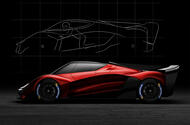
Dutch start-up Sanrivatti has shown its first prototype, the One, a track-only hypercar that asks the driver to lie head-first on a centrally mounted frame, much as a motorcycle rider tucks in over a tank. The company calls this the "Apex position" and says it gives a clearer view ahead than a conventional seat while tying the driver more closely to the car. Founder Santiago Sanchez told Autocar that the layout turns the usual supercar cockpit on its head. Instead of reclining and watching the road rush past, the driver is braced in an active, aggressive stance and is heading into corners rather than having them arrive.
Despite the motorcycle influence, the car keeps a conventional steering wheel and pedals. Sanchez says these will be linked mechanically to the steering and brakes rather than by wire. The posture is not fully prone, either. Sanrivatti says it has searched for a middle ground between a superbike stance, which puts heavy strain on the rider's body, and one that feels too passive. To deal with the lateral loads a car can generate through corners, the company is developing a "G-force neutralising system." Sanchez described it only as a "kind of leaning mechanism" and declined to say more while development continues.
Power comes from a 789bhp naturally aspirated Judd V10, a choice the company made because it considers it the most emotional-sounding F1 engine. The target is a 1100kg dry weight and a 205mph top speed. Sanchez said the car was designed with the Spa-Francorchamps circuit in mind, but insisted that numbers are not the point. The more interesting engineering question is the driver. In most supercars, the 60 to 100kg of a person sits as low and far back as possible. Here it sits high and close, which changes steering geometry, suspension geometry and how the car behaves. A leaning system that moves that mass during a drive would add another layer of complexity.
Sanchez said crash safety was the first question the team asked itself and claimed the head-first position would not compromise it. Sanrivatti also plans a staged driver development programme so buyers can learn to handle the car, particularly at high speed. Supporting the project is Paul Arkesden, who led engineering on the McLaren P1, later ran vehicle development for McLaren Special Operations, and became vice-president of engineering and product development at Singer.
These are still company claims, and the car exists so far only as a prototype. Building a niche hypercar by 2030 is an ambitious timeline for a young firm, even in a market that has grown quickly. Sanchez has hinted that the Apex position could eventually reach road cars, but for now he says all attention is on the One.
Reporting based on an external source.