 Carinsider
Britain's Best Driver's Car 2026: Three Supercars Meet Welsh Rain
Group Tests·November 19, 2026
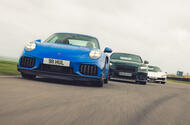
The supercar stage of this year's Britain's Best Driver's Car contest set three very different machines against each other, and the weather made the job harder than the spec sheets suggest. The Porsche 911 Turbo S, Ferrari 296 Speciale and Bentley Supersports were all tested on greasy Welsh B-roads, then moved to a dry Anglesey track for the performance tests.
Porsche has won the contest a record 14 times and Ferrari five times, so the 911 and the 296 start with reputations that precede them. The judges were clear that those reputations count for nothing at the start of each year. Performance on the road and track decides the result, and on a damp day the roads themselves became the biggest test.
The Bentley had the toughest time. The Supersports is a stripped-down, rear-driven, V8-powered version of the Continental GT, and its 590lb ft of torque from a 4.0-litre engine repeatedly threatened to overwhelm the rear tyres. Drivers had to ease off to around half their usual pace, and even then the car was hard to keep settled. Its steering was pleasingly direct and the V8 sounds wonderful, but on wet roads it felt disjointed. On track, the electronic limited-slip diff stepped in to protect itself under load. The verdict was that the car probably won't make it to the final shootout.
The 911 Turbo S won praise for being almost frighteningly capable. Its damping is excellent, ride and control work together, and the grip is so high that it rarely puts a foot wrong. It lacks the sharpness of a GT3, and the steering feels heavier than ideal, but the way it turns power into composure is hard to fault. Judges also noted that it feels smaller than its numbers suggest, which matters on narrow roads.
The Ferrari was the most demanding of the three. Its magnetorheological dampers and fast steering felt unfamiliar in the wet, and the car needed a sensitive touch before it settled. Once drivers adapted, though, it became the quickest car over a point-to-point route in these conditions. The 2992cc V6, with its electric assistance, delivers drama at lower speeds without needing full power, which the judges felt was the 296 Speciale's real strength.
Part two of the coverage makes clear how far the word supercar has stretched. These three cars cover very different ideas of what a supercar is, and the wet roads of Wales exposed each one's character.
Reporting based on an external source.