 Carinsider
Spyker's Strange, Speedy Century Gets Another Comeback Try
Brand History·November 13, 2026
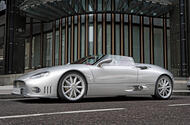
Spyker says it is back in business, and this time there is hardware to point at as well as a press release. The brand's latest backer is described as a "fintech ecosystem" that wants to "integrate a sports car with blockchain products," a pitch that will make many longtime observers wince. The more convincing evidence came in two displays: an "entirely new" C8 Preliator XXV Coupé shown at Pebble Beach, and a parade of 22 older C8 Spyders at the Dutch Grand Prix. It has been more than ten years since Spyker last handed a new car to a customer, and less than thirty since the company unveiled a drooping prototype at Goodwood.
The name goes back much further than the C8. At the 1903 London motor show, Spyker's 20hp tourer impressed observers with a bonnet that clamped down without screws or clips, and a gearbox interlock that stopped the driver from changing gear until the clutch was disengaged. Later that same year, the Dutch firm produced a six-cylinder car with two driving axles, which later writers would recognize as an early four-wheel-drive machine. Spyker had a reputation for careful engineering from the very start.
Its most dramatic early moment came in 1907 in the Peking to Paris rally, a grueling 9,300-mile event. A Spyker finished, but about a fortnight behind the winner. Its driver, Charles Godard, was removed from the car by Spyker's own Jacobus Spyker when the team reached Germany. Godard had misrepresented who was backing the trip to get the car, sold off spare parts along the way, and misled shipping companies and banks to fund his onward journey. Few rally stories end with the car's owner taking the wheel to eject the driver.
The company's luck turned sharply that same year. Jacobus's elder brother and business partner, Hendrik-Jan, drowned when a British ferry sank in a storm, about six months before the rally finale. The loss was followed by bankruptcy and new ownership. The First World War then rescued the struggling firm, which moved into military aircraft production. The know-how paid off in 1919 with the Aerocoque, a sports car whose body was shaped like an aeroplane fuselage, with mudguards that followed a wing profile. It was an odd machine, and it was bought by Major Hawker, who evidently lost interest quickly. Within months, a dealer was advertising it for sale in Autocar.
Spyker was still producing road cars, and in 1921 Autocar tested one. A 70bhp five-seat tourer, it was pushed to £2,600 by import duties, roughly £113,700 in today's money. The reviewer thought it was worth the price, praising its silky six-cylinder smoothness, light steering for its size, and suspension that kept the body level over bad surfaces. The verdict was that it corners well and handles with more composure than its weight suggested.
That same easy-going character, combined with an ambition to be different, came back in the C8. Early test drives in 2004 praised a car that borrowed nothing from Ferrari or Lamborghini, even as they flagged the need for more communicative steering, better front-end grip, and sharper gear ratios. Whether the latest revival can finish what those early cars started remains an open question. The C8 showings are a start, but Spyker's history suggests the road back has never been straight.
Reporting based on an external source.