 Carinsider
Saab's Road Cars Carried Real Jet Engineering, Not Just Hype
Classics·October 21, 2026
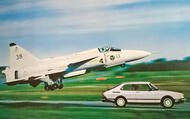
Saab is remembered for turbochargers, quirky ignition keys and a loyal following, but the company began in aviation. Svenska Aeroplan Aktiebolaget was founded in 1937 by the armaments maker Bofors as war loomed over Europe. It joined two aircraft firms, one in Trollhättan and one in Linköping, to supply the Swedish air force with fighters and bombers. When the war ended, the company needed new work, and it turned to cars.
Wing engineer Gunnar Ljungström was put in charge of the project. He had previously developed transmissions for Standard Triumph and Rover, but by his own account he was no car enthusiast. Of the 15 people on his team, he said, perhaps two held driving licenses. The result, the 92, carried an aircraft mindset in its design. Its pear-drop body was shaped to slip through the air, its structure was light and rigid, and it had no conventional chassis. Contemporary road testers praised the team for building a small, inexpensive car that, in the words of one reviewer, "has everything."
Saab's advertising kept drawing the connection. From 1960, its brochures set the 96 beside the Draken supersonic fighter, linking the car's sleek lines and efficient engine to the jet. In 1964, the braking system was sold as "super-safe," with dual independent master cylinders feeding diagonal pairs of wheels. The aviation habit even reached the factory floor. Trollhättan's fuel-system test rig was built so that in an explosion its walls would blow outward, a method the aircraft division at Linköping already used.
Aerodynamics was where the transfer mattered most. Wind-tunnel development helped the 99 of 1967 reach a drag coefficient of 0.37, while most European saloons of the time sat between 0.40 and 0.45. Its shape was also tuned to keep the center of sidewind pressure close to the center of gravity, which reduced the yawing caused by crosswinds.
The cabin followed the same logic. Saab's mid-1980s 900 used round dials, which the company said aircraft use because pilots notice changes in a large needle more quickly and accurately with peripheral vision than they do with changing digits. Its advertising went further. It paired the Mach 2 Viggen fighter with the line "Nothing on earth comes close," and compared Saab drivers favorably with owners of Jaguars, BMWs and GTI hatchbacks.
Not every claim held up. A reader pointed out that the Viggen's turbofan was made by Volvo, not Saab. Saab GB's boss said independent research showed the campaigns worked. Technical chief Stig-Göran Larsson described a more substantial link. Trollhättan's aerodynamicists sent their work to Linköping for checking, the Cray supercomputer there was borrowed for especially hard problems, and the two sites shared knowledge of composite materials for car parts. The connection was real, even if the ads oversold it.
Reporting based on an external source.