 Carinsider
Four Race Weekends in a Day: How Simulators Are Reshaping F1 Academy Prep
Motorsport·November 16, 2026
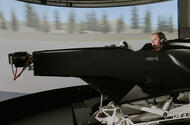
Racing drivers have long heard that seat time wins races. For a teenager in a six-round, all-female series with only five real-world tests a year, that idea has turned simulators from a useful extra into the center of her preparation.
Rachel Robertson, 19, races in F1 Academy, a series that runs alongside selected Formula 1 weekends. She didn't start karting until she was 14, which she admits left her roughly a decade behind rivals. She has spent the years since closing that gap, first with a scholarship in a Radical championship and then with sponsorship that brought her into F1 Academy. After a rough opening to the season, her results have picked up, and she has scored points in each of the last four races.
The rest of the grid is not on equal footing. Of the 18 drivers, 11 are backed by F1 teams with access to their own simulators, and many of them also race in other championships. Robertson is not one of them, so simulator time matters even more for her.
Her team, Hitech, is based in Silverstone and has a simulator of its own. Robertson also trains on a rig built by Ansible Motion, a Norfolk company that is outgrowing its current home and building a new facility. The Ansible setup runs rFpro, an industry-standard simulation package. The series does not share its full technical data for the F1 Academy car, so the team modified a Formula 4 car to handle much like the real thing. Robertson says the result is "almost identical."
The main benefit is volume. Robertson says that on a typical day her team can cover the equivalent of three or four race weekends. Even on a day with a visiting journalist, she completed more race laps on the simulator than a full real-world weekend offers, which typically includes only a few practice and qualifying sessions and two or three 25-minute races. Laps that once went to learning a layout can now go to pushing.
The rig is built to feel right. A carbon fiber driver cell, once part of a real single-seater, sits on struts and beams that provide pitch, roll, yaw, sway and surge. Input latency is under 15 milliseconds, which the brain barely registers. Steering weight and brake feel match the car, and the harness tightens under braking. The one thing it cannot reproduce well is sustained g-force. Ansible's latest machine adds full 360-degree rotation and a 10-meter screen, and five 240fps projectors feed the picture. The rig draws about 1 to 2 kilowatts in typical use, roughly the same as a kettle.
Simulators also serve car makers. A Delta S2 unit is heading to the University of Bath's IAAPS lab, where it will be linked to a 2,413bhp four-wheel-drive powertrain test rig. That setup lets engineers check durability and drivability in one environment while the simulated car runs in another. For Robertson, though, the point is simpler: more laps, more learning, and more chances to race when the real calendar offers so few.
Reporting based on an external source.