 Carinsider
Chinese Carmakers Revive the World Car as Premium Brands Retreat From It
Industry·October 22, 2026
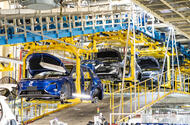
Renault's latest move shows how far the idea of a global car has come back into fashion. At a recent event in Brazil, the company marked the start of production of the Geely EX5 electrified SUV at its local plant. It is essentially the same vehicle sold in China, Europe, the UK, Australia, Chile and Mexico. Renault will build it on the same line as the Boreal, a compact SUV derived from the Dacia Bigster that is sold in 54 markets. CEO Fabrice Cambolive said the industry's new trends are changing the game, and that Renault intends to follow the Chinese makers in pursuing global cars.
The reason this works now is cost, not styling. Chinese companies combine a low-cost manufacturing base with strong technology, so they can put a well-equipped car on sale cheaply enough that customers in very different markets accept it. Earlier attempts at global models failed because European, Japanese and American cost structures could not compete everywhere, not because one car could never suit many countries. Size often follows price too. In Brazil, where small cars dominate, a larger SUV with a surround-view camera and plug-in hybrid drivetrain at a similar price can persuade buyers to trade up. UBS analyst Patrick Hummel said compact and mid-sized SUVs are in demand across many markets, which makes them easy to export.
Premium brands face the opposite problem. Their ability to sell nearly identical cars worldwide is fading as the three biggest markets, the US, Europe and China, pull in different directions. Volvo's outgoing CEO Hakan Samuelsson told investors that globalisation, meaning one car built in one factory and sold everywhere, worked in the past but will not work in the future. Volvo is developing six models just for China, and Audi has launched a separate brand there. Audi's chief technical officer Rouven Mohr has said the single world car is effectively gone. Building different cars for different markets is expensive, and JLR's finance chief has warned that running separate software stacks for the US and China adds cost that the company would rather avoid.
Ultra-luxury brands have fewer options, so they are sticking with global platforms while struggling to keep up. Porsche expects China to fall to less than 10 percent of its sales, and its CEO has said a recovery there is not in the plan. Jaguar's managing director Rawdon Glover argues that building separate vehicles for Europe, China and North America is not economical. Analysts often cite the Tesla Model Y as the best recent example of a global car, since its pricing pulls buyers into a size class they might otherwise skip.
The limits are real. Chinese makers have been building cars for their home market first and exporting what sells there, and their current trend toward SUVs longer than 5 metres may not sell in volume abroad unless the prices are low enough. Washington's ban on Chinese connected-car software from 2027 models, and on Chinese hardware from 2030, adds another barrier. The global car remains the goal, but with globalisation in retreat, it is harder to reach than it was.
Reporting based on an external source.