 Carinsider
BMW's Electric M3 Prototype Makes a Strong Case as the Best Driver's EV
First Drives·November 17, 2026
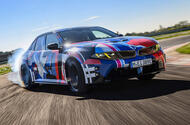
BMW invited journalists to its Miramas proving ground near Marseille to sample the electric M3 ahead of customer deliveries in June next year. The first taste came from the passenger seat, where a demonstration lap showed how quickly the car reacts on corner entry, mid-corner and exit. Behind the wheel, the impression held up. The hardware is largely settled, and the figures still being finalised are small tweaks to the dynamics rather than changes to the car itself.
The M3 uses the i3 as its base but gets its own M-specific battery cells, new battery cooling, reinforced underbody plates, strengthened mounts and largely new suspension, with MacPherson struts at the front, a five-link rear and adaptive dampers. Four motors, one per wheel, produce up to roughly 838bhp, with the front pair contributing up to about 644bhp and the rear pair up to about 751bhp. The battery is over 100kWh. Regeneration can reach 540kW, which BMW says is up to the grip limit of the tyres. BMW has not published a kerb weight, but the car is likely to be near 2,400kg, and the engineers acknowledged that the extra motors add significant mass.
The reason for four motors is response. BMW engineers say conventional drivetrains and hydraulic brakes can take up to 300 milliseconds to respond, and anything above 150 to 200 milliseconds is noticeable to a driver. Electric motors react far faster, to the point where BMW has had to deliberately dial back their responsiveness. In practice the car brakes mostly through regeneration rather than pulsing ABS, which keeps it near the edge of grip. After five fast laps, the front discs remained under 100 degrees Celsius, far below the 600 degrees that might be expected, and cooler brakes are also easier on the tyres.
Handling is set up to feel like a rear-biased sports car. In its milder modes it understeers in a steady corner, as expected, but it can be coaxed into tightening its line on power if the entry speed is right. Sportier settings let the rear step out more freely, and a rear-drive-only mode is available for efficiency or sliding. Six selectable "stages" mimic gears, complete with a rev-style limit and a changing sound. BMW insists they are not gears, and turning off the sound can make the car feel strangely detached.
The figures remain estimates, including 0 to 62mph times, a claimed range of around 400 miles and a price near £100,000, and the final tuning is still a few percent away. Even so, the early verdict is clear. The M3 feels precise and immediate in a way few electric cars do, and it suggests that electrification need not dilute the M badge. The forthcoming electric Porsche Boxster will be the next test of that claim.
Reporting based on an external source.